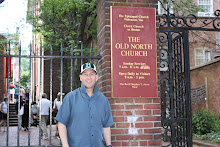
This morning our congregation will experience the resignations of three of our seven Elders. David Bailey has been serving as an Elder among us for about 15 years. Bud Ashby has been serving among us for over 10 years, and David Lidbury, after having served as an Elder in other places, has been serving as an Elder among us for about 5 years. I will miss the contribution each has made to our church and, more specifically, our leadership team.
The role of "Elder" in a church is, I think, too often taken for granted. These men do not stand up each Sunday and list for the church the things they have done for them in the previous seven days. And, in a culture that tends to enjoy challenging leadership and negatively criticizing it, there is not enough admiration, respect, and dignity held in the minds of sheep toward their shepherds, as is warranted. This is even more so the case when you have Elders like Bud, David, and David who serve with such distinction. We as a church have been richly blessed by God with the Elders He has appointed among us. Their collective wisdom, vision, commitment to the Kingdom, godly character, devotion to Scripture, cooperative spirit, willingness to work hard, willingness to make sacrifices, willingness to put their own interests aside for the greater good, desire to see the lost come to Christ, care for people, prayerful attitudes, and many other virtues make them worthy of the church's appreciation and admiration. We have been served well. Bud, David, and David, thank you.
If you can hear me the way that I mean this, the resignations of these three come at a good time, a healthy time, with a positive outcome for our church likely to be the result. I think each of these men would say that their resignations come at a time when the church is able to handle Elder resignations. There is currently a high level of alignment within our leadership, a solid direction in which we are heading, a positive feeling that God has been blessing us, and a sense that healthy transitions within our leadership team can include the passing on of responsibilities from some current leaders to both incumbent leaders and to some new leaders who will make their own valuable contributions to leadership within our church. Transitions in leadership can be healthy, and in this case the healthy benefits extend both to the future of the life of our church and to the personal futures of those who are resigning. No doubt, the levels of service we enjoy in the cases of these three will be reduced in some ways, but largely it will simply be altered, so that their "official" responsibilities will now change, without any reduction in their devotion to the ministry of our church, to their support of its ministry, to the church's vision, and to the leaders they will in one sense now be following. In fact, because true Shepherds shepherd, whether they are officially serving in the role of Elder within a church, or not, we will continue to see Bud, David, and David "Eldering" within our body.
So, despite a certain sadness I feel in seeing such wonderful Shepherds move aside, I look forward to the ways in which God will use this occasion to bless our church. Leadership change can bring about opportunities and renewal; leadership change can propel forward a church's ministry in ways not previously experienced. Think of what the church would have been like if Paul had not become an apostle, supplementing the ministry of those who had been with Jesus when He ministered on earth! Among us, whom will God raise up to do wonderful things as new Shepherds, who would not have taken on a new role had our experienced Elders never transitioned from their roles? In what new ways will our church's ministry be enhanced because the dynamic among our leaders has been altered, guided by God's Spirit just as the Spirit was guiding us when those resigning this morning served as designated Elders?
This all looks good to me. Bud, David, and David have served well and deserve to make a transition. They have helped to put us in a position where God can build on what they have done to create a blessed future for our church. I greatly look forward to the days ahead!
Sunday, November 20, 2011

Wednesday, August 10, 2011
Deposing Anti-Intellectualism
In a recent blog entitled "Beyond Cynicism 4," Scot McKnight continues his discussion of Andrew Byers' book Faith Without Illusions. I then mentioned in an email to our church that I especially liked this fourth entry in McKnight's series. Rhandi Tyssen, one of our members, wrote back and asked why I liked this one best. Here is my response:
Because it speaks against anti-intellectualism, which has certainly been a problem in the C of C. I have heard come out of the mouths of our people some of the exact quotes Byers/McKnight mentions as prevalent among anti-intellectuals. On the other hand, I virtually never hear academics and intellectuals speak badly of the average person in the pew, because they know that their education or erudition does not justify such attitudes; but anti-intellectuals often accuse the educated of thinking that they are better than the uneducated. So, you end up with the uneducated being more often prejudiced against the educated than the other way around, all because the uneducated feel like the educated are slighting them! Anti-intellectualism ends up hurting the church more than helping, just like hypercriticism against leaders or teachers does more harm than good. Ultimately, I think all this comes down to self-esteem. The uneducated feel deprived, or intimidated, or jealous, or denigrated by the educated, and so a diminished self-esteem causes them to respond negatively to intellectuals, when the poor intellectual was just trying to learn more and then to help others discover the things they had learned! True intellectuals don’t look down on the uneducated and ignorant, because they know how ignorant they themselves are about so many things.
Saturday, August 6, 2011
Wanting to Understand Islam Well, With Fairness
There is much being written about Islam and how we as Christians are to understand it. For example, just how separated in our minds should Islamic fundamentalist terrorism be from the core of the Islamic faith? Is Christianity just as guilty or reprehensible in places as the parts of Islam that are reprehensible? In a blog sponsored by Ben Witherington III from August 3,
(http://www.patheos.com/community/bibleandculture/2011/08/03/the-norway-killings-what%e2%80%99s-the-truth-about-islam-christianity-and-violence/)
Witherington makes comments about the recent massacre in Norway and moves from there to discuss Christian attitudes toward Islam. In response I have commented several times. If you are interested you will want to go to Witherington's blog and see the thread, but, I thought I would include here my comments in reponse #44:
Aside from Ben’s description of Koranic literature as proverbial, aphoristic, sapiential (which it seems to me inadequately addresses the content of texts like the ninth Sura and their place in Islam), I still have not seen one comment that denies the significant difference between Islamic origins and Christian origins with respect to elements of violence being inherently part of the life of the founder and of the foundational literature. This seems to me important. There seems to be clear evidence that Koran and Hadith advocated violence against infidels and that Muhammad and some of his immediate successors carried out violent acts against infidels. Is this true and accurate or not? Juxtaposed, there seems to be nothing in the New Testament, and nothing in the life of Jesus, that advocates, examples, or even passively permits violence. Christian origins move entirely in the opposite direction of violence, despite whatever the followers of Christ have done in living out their faith. Is this true and accurate or not? This does not let Christianity off the hook for its history. This does not deny the gains made by contemporary Muslims or by Muslims throughout history. This does not allow for Christian smugness or self-righteousness or judgmentalism. This does not allow for the Americanization of Christianity, nor does it defend the legitimacy of manifest destiny, both of which are truly aberrations from Christianity. This doesn’t defend the horrors of the recent acts in Norway or serve as a means of separating modern Christian perspectives in some circles from violence. But, IMO, origins count for something and help to explain. Ken and others have argued effectively, I think, that this is the case, and it seems to me that these arguments (which don’t at all appear to be assumptions or misinterpretations of evidence available to all, nor are they jingoistic in character) require answers that are different than: accusations hurled at the mistakes of Christians, or mention of the truth that the vast majority of Muslims are non-violent and abhor terrorism, or assertions that the Koran may permissably be intepreted differently by Muslims today, or claims that argue that it is a mere caricature of Islam to assert that there was from the beginning violence within Islam. Such argumentation does not count for nothing, but original, paradigmatic texts and the lives of the founders of religions must be given their due, it seems to me, in considering what our opinions should be of those religions.
The long and short of this for me is that it is simplistic and inaccurate to make similar claims about the origins of Christianity and its link to violence or non-violence and the origins of Islam and its link to violence or non-violence. Further, the differences between these two faith systems on this score, seem to me to be very important in formulating opinions about the fundamental character of these two faiths.
(http://www.patheos.com/community/bibleandculture/2011/08/03/the-norway-killings-what%e2%80%99s-the-truth-about-islam-christianity-and-violence/)
Witherington makes comments about the recent massacre in Norway and moves from there to discuss Christian attitudes toward Islam. In response I have commented several times. If you are interested you will want to go to Witherington's blog and see the thread, but, I thought I would include here my comments in reponse #44:
Aside from Ben’s description of Koranic literature as proverbial, aphoristic, sapiential (which it seems to me inadequately addresses the content of texts like the ninth Sura and their place in Islam), I still have not seen one comment that denies the significant difference between Islamic origins and Christian origins with respect to elements of violence being inherently part of the life of the founder and of the foundational literature. This seems to me important. There seems to be clear evidence that Koran and Hadith advocated violence against infidels and that Muhammad and some of his immediate successors carried out violent acts against infidels. Is this true and accurate or not? Juxtaposed, there seems to be nothing in the New Testament, and nothing in the life of Jesus, that advocates, examples, or even passively permits violence. Christian origins move entirely in the opposite direction of violence, despite whatever the followers of Christ have done in living out their faith. Is this true and accurate or not? This does not let Christianity off the hook for its history. This does not deny the gains made by contemporary Muslims or by Muslims throughout history. This does not allow for Christian smugness or self-righteousness or judgmentalism. This does not allow for the Americanization of Christianity, nor does it defend the legitimacy of manifest destiny, both of which are truly aberrations from Christianity. This doesn’t defend the horrors of the recent acts in Norway or serve as a means of separating modern Christian perspectives in some circles from violence. But, IMO, origins count for something and help to explain. Ken and others have argued effectively, I think, that this is the case, and it seems to me that these arguments (which don’t at all appear to be assumptions or misinterpretations of evidence available to all, nor are they jingoistic in character) require answers that are different than: accusations hurled at the mistakes of Christians, or mention of the truth that the vast majority of Muslims are non-violent and abhor terrorism, or assertions that the Koran may permissably be intepreted differently by Muslims today, or claims that argue that it is a mere caricature of Islam to assert that there was from the beginning violence within Islam. Such argumentation does not count for nothing, but original, paradigmatic texts and the lives of the founders of religions must be given their due, it seems to me, in considering what our opinions should be of those religions.
The long and short of this for me is that it is simplistic and inaccurate to make similar claims about the origins of Christianity and its link to violence or non-violence and the origins of Islam and its link to violence or non-violence. Further, the differences between these two faith systems on this score, seem to me to be very important in formulating opinions about the fundamental character of these two faiths.
Sunday, June 12, 2011
Every Christian experiences spiritual ebbs and flows or periods when there is less fervor; less hunger. I may be coming out of a time like this. I could feel the sense of dissatisfaction in my soul as I woke up this morning; dissatisfaction with where my spiritual life has been of late. I awakened praying, as if I had already started reaching out to Him in my dreams. I so wanted to read Scripture. So, wanted to turn a corner and start again. Remaining in bed was no option. I want to go through a period of re-energizing, like I have done a thousand times before. Christianity is not for most a constant rise upwards, but a series of undulations, like the typical charts I see that track the growth of blue-chip stocks. What one must see is the big picture of growth over the years, without being either elated or deflated by the daily vagaries that come with immediate successes or failures or momentary victories or disappointmens. So, I will die to self, again, like Paul dying daily, only to find that the One who gives life to all has been faithful, waiting to revivify me. Perhaps this time the fervor, the hungering, will last longer. Perhaps it will be a bit more heightened, more intense. Perhaps the ebb, when it comes, will be of less duration. We will see, but in this moment, with apologies to Dick Vitale, it's stock up!
In the last couple of weeks we have enjoyed the blessings of three baptisms through the ministry of our church, with the converted coming from the world, not from one of our families, and conversions like these are always especially encouraging. Some intentional nurturing is in order!
In the last couple of weeks we have enjoyed the blessings of three baptisms through the ministry of our church, with the converted coming from the world, not from one of our families, and conversions like these are always especially encouraging. Some intentional nurturing is in order!
Tuesday, April 26, 2011
A Healthy Approach to Asking Questions and Finding Answers
Searching questions by faithful people can be very valuable, and God knows the numbers of times when I have asked questions about Christianity, addressing such questions both to myself and in dialogue with others. I definitely appreciate the God-created part of us that seeks after truth, with no sincere, reasonable question being out of bounds. This is one of the best things that God did in creating us. My own response to such questions in my life has been to do tons of reading, both of solid believers and of those who are not, in order to hear the best of both arguments. So I have read ancient critics like Celsus, ancient gnostic heretics, ancient philosophers, and lots of church history, whether doctrinal history or just church history. I have also tried to read modern secular philosophy, especially those who directly challenge the Christian faith (like a David Hume or Feuerbach or Nietzsche). I have also read much in the area of NT criticism and critical theology, including FC Baur, DF Strauss, Bultmann (lots of Bultmann), Dibelius, Schweitzer, Norman Perrin, Schubert Ogden, and the Jesus Seminar guys and their friends (Spong, Borg, Crossan, Funk). I have also read those who critique the challengers of Christianity, like Ben Witherington, NT Wright, Scot McKnight, and a number of others who have written alongside or who have preceded these three (FF Bruce, Ralph Martin, Ward Gasque, TW Manson, Charles Moule, and many others). My point is not to give my reading resume, it is to say that some of those whom I read or with whom I have personal discussions are motivated for whatever reason to ask/answer tough questions without being willing to turn over every rock for clues, and I think this greatly hampers their searches. I personally know several former Christians who lost their faith because they read a few critical voices and stopped there, convinced that the faith side of things had little or nothing to say in response. They were/are wrong. Read Borg, but read NT Wright (and not just the popular stuff he writes). Read Crossan, but read Ben Witherington. Writers like Wright and Witherington are of substantial ability, trained by some of the best, and they make defensible arguments that give credence to Christianity. Read William Lane Craig, Anthony Thiselton, and Kevin Vanhoozer. All of these faith-filled writers are acutely aware of all the critical issues, and they still believe in the Resurrection! The idea that the critics are the ones who have a corner on honest seeking, sound logic, and historical exactitude is inaccurate and a distortion.
I write such things because we are all called to be ready to give an answer for the hope that lies within us. I also want for the some or many who have questions to understand that discerning, challenging questions can be asked and answered in a context of absolute faithfulness. The truths of Christianity and the integrity of the Bible can be rationally and spiritually upheld in the context of vigorous intellectual discussion and rigor, and we as traditional, orthodox Christians have nothing to fear from the critics, the philosophers, the academics, the intellectuals, the scientists, or whomever you wish to read--unless we refuse to give as much place to the defenders of the faith as we do to the critics. Just as bad as a closeminded Christian is a closeminded critic or heretic who rules out the thoughts of defenders of the faith as if there is not a chance that the faithful could be correct or as if the faithful are the only ones unwilling or incapable of thinking and researching well without bias. I have given abundant room to the critics in my own personal search; searchers, seekers, and critics need to extend the same effort in giving room to qualified, respected defenders of Christ.
I write such things because we are all called to be ready to give an answer for the hope that lies within us. I also want for the some or many who have questions to understand that discerning, challenging questions can be asked and answered in a context of absolute faithfulness. The truths of Christianity and the integrity of the Bible can be rationally and spiritually upheld in the context of vigorous intellectual discussion and rigor, and we as traditional, orthodox Christians have nothing to fear from the critics, the philosophers, the academics, the intellectuals, the scientists, or whomever you wish to read--unless we refuse to give as much place to the defenders of the faith as we do to the critics. Just as bad as a closeminded Christian is a closeminded critic or heretic who rules out the thoughts of defenders of the faith as if there is not a chance that the faithful could be correct or as if the faithful are the only ones unwilling or incapable of thinking and researching well without bias. I have given abundant room to the critics in my own personal search; searchers, seekers, and critics need to extend the same effort in giving room to qualified, respected defenders of Christ.
Sunday, April 24, 2011
From Oscillation to Consistent Progress
While the general tenor of my perspective on the church is positive (how could it not be in light of Jesus, especially on Resurrection Day?!), a number of realities cause me to daily oscillate in my feelings about how things are going. I look at the health and progress of a capella Churches of Christ in western Canada and I think, "Whoa, we're in big trouble, we have virtually no impact in our communities!" Then I electronically dialogue with Blair Roberts, or have a phone conversation with Kevin Vance, or hear about something that Zambia Mission Fund--Canada has done, or talk to Colin Hattrick or Jordan Clark, or have a meeting with Darcy and Hope, or see the positive things happening with our young adult ministry at Calgary C of C and I think, "We have every reason to be hopeful." Then I think about how apparently unimportant Sunday morning worship is to some Christians when I don't see them for weeks, and I say to myself, "The desires of the world are largely controlling our choices and priorities." Then I watch Larry and Joann Luck come on a Saturday and fill our pantry so that we can feed the needy, and I am so pleased with the church's ministry to those around us. Then I talk to someone about their habits with respect to spiritual disciplines, and I think, "I don't know if any of our people are consistently spending time in Scripture." Then I get a devotionally oriented book for a relatively new Christian like Andrea Milner, and she gobbles it up and tells me about how she and Kaitlyn read the Bible together.
I do think that Churches of Christ in western Canada and the church I serve have a long way to go in order to be what Christ wants us to be. In many ways we are essentially irrelevant, in fact, we are statistically almost non-existent in our cities, in that, we impact such a relatively small part of our populations. But as long as there continue to be Resurrection days, there will continue to be life in our churches, with opportunities to move forward from here and to have the kind of impact in our world that God wants His Kingdom to have. This will require that our young take the ministry of the church seriously and that they play a significant role in the body of Christ. This will require that the our choices and priorities regarding our time be primarily governed by the gospel and the Kingdom. This will require that we increase the level of our service to the needy of our communities. It will require that we possess biblical attitudes toward our Elders and their leadership, rather than the immature questioning of them that I hear too often (there is a mature way to question leaders, but most of what I hear is not this). It will require that we, at my own church, take seriously the plan for discipleship that our Elders have adopted, so that we work the plan. It will require a love for the lost that supersedes our love of self, permitting us to outwardly focus. It will require that families make financial sacrifices for the good of the Kingdom. It will require that a new generation becomes significantly interested in the spiritual disciplines of prayer, study, giving, service, and worship. And with these things, and many more, as possibilities, it seems we have a chance to consistently move forward. Because God is always there ready to bless, the oscillations present in my own perspective can be replaced by not just consistent hopefulness, but by consistent joy as we see the progressing of the Kingdom that God wishes to work among us.
I do think that Churches of Christ in western Canada and the church I serve have a long way to go in order to be what Christ wants us to be. In many ways we are essentially irrelevant, in fact, we are statistically almost non-existent in our cities, in that, we impact such a relatively small part of our populations. But as long as there continue to be Resurrection days, there will continue to be life in our churches, with opportunities to move forward from here and to have the kind of impact in our world that God wants His Kingdom to have. This will require that our young take the ministry of the church seriously and that they play a significant role in the body of Christ. This will require that the our choices and priorities regarding our time be primarily governed by the gospel and the Kingdom. This will require that we increase the level of our service to the needy of our communities. It will require that we possess biblical attitudes toward our Elders and their leadership, rather than the immature questioning of them that I hear too often (there is a mature way to question leaders, but most of what I hear is not this). It will require that we, at my own church, take seriously the plan for discipleship that our Elders have adopted, so that we work the plan. It will require a love for the lost that supersedes our love of self, permitting us to outwardly focus. It will require that families make financial sacrifices for the good of the Kingdom. It will require that a new generation becomes significantly interested in the spiritual disciplines of prayer, study, giving, service, and worship. And with these things, and many more, as possibilities, it seems we have a chance to consistently move forward. Because God is always there ready to bless, the oscillations present in my own perspective can be replaced by not just consistent hopefulness, but by consistent joy as we see the progressing of the Kingdom that God wishes to work among us.
Saturday, April 9, 2011
New Canadian C of C Survey
Geoff Ellis, a long time leader in Churches of Christ in Ontario and closely connected with Great Lakes Christian College, has sent out survey info requests for a capella Churches of Christ in Canada. I appreciate Geoff very much in doing so, and his efforts caused me to think about where our Movement is in Canada (the Stone-Campbell or Restoration Movement, that is), especially in western Canada, which is, of course, where I have spent the majority of my adult life and ministry. One question I have is about the churches to which Geoff sent the survey and how he decided those to whom he would send it? I need to ask him, of course, but did he send it to the Shelbourne St. C of C in Victoria, which has for several years now used instruments in worship? Did he send it to the Glen Elm C of C in Regina, which now uses instruments on Sunday mornings about half the time? Another question I have concerns the number of churches which have disbanded. If there is a C of C family or two left in a city or town, but no formal meeting of the church with several families typically meeting at some central location, is this still a church that will be surveyed? I wonder if he will be aware of whatever church plants may have taken place and be able to contact them for their info? Mostly, I am, of course, interested in the results of the survey. My impression is that the still purely a capella churches are for the most part really struggling in western Canada, with there having been no a capella churches in western Canada experiencing notable growth during the last five years, and very few new a capella churches started (I know only of the newer one in Edmonton, and I don't know how they are doing. I know Tim J. is moving to Barrie). If you are a reader of this, I would love to hear if you know of something different. IF my description is accurate, and we are for the most part struggling, I would think that those of us who are leaders in our churches need to seriously consider (or re-consider) what we have been doing. What kind of revival may be in order? What shifts in thinking or method need to take place ? I would think it unlikely that any of us would want to just continue down the same path, which appears to be heading in the direction of a long slow death, with the gates of hell clearly prevailing against the church. Thoughts?
Subscribe to:
Posts (Atom)